Illustration of a peptide chain above a mass spectrum showing b and y ion peaks, representing peptide identification methods.

How Are Peptides Identified in Laboratories?

For Research & Development Use Only. Not for human consumption, medical use, or therapeutic applications. Quick facts A vial label says what a material is meant to be. Analytical data shows whether the evidence supports that label. This guide sets out the main peptide identification methods used in research laboratories, with worked numbers, comparison tables

How Are Peptides Identified in Laboratories? Read More »

Alluvi guide to understanding peptide research information and scientific evidence.

What Should You Know Before Reading Peptide Research Information?

1. Understand what a peptide is, and why the term is broad Peptides are short chains of amino acids joined by peptide bonds. There is no single universal cut-off, but chains of roughly two to fifty residues are usually described as peptides, with longer chains generally called proteins. That range covers a huge variety of

What Should You Know Before Reading Peptide Research Information? Read More »

Diagram of the peptide purity testing control pipeline from synthesis through hplc, mass spectrometry, and endotoxin testing to a certificate of analysis

Peptide Purity Testing: The Complete Guide to Verifying Quality (2026)

Peptide Purity Testing: Why It Matters More Than You Think A vial labelled “99% pure” tells you almost nothing on its own. Purity claims are only as good as the testing behind them and in the research peptide market, the gap between a rigorous Certificate of Analysis and a document designed to look convincing without

Peptide Purity Testing: The Complete Guide to Verifying Quality (2026) Read More »

Comparison chart of hplc, mass spectrometry, nmr, amino acid analysis, and endotoxin testing by speed, cost, and what each method confirms

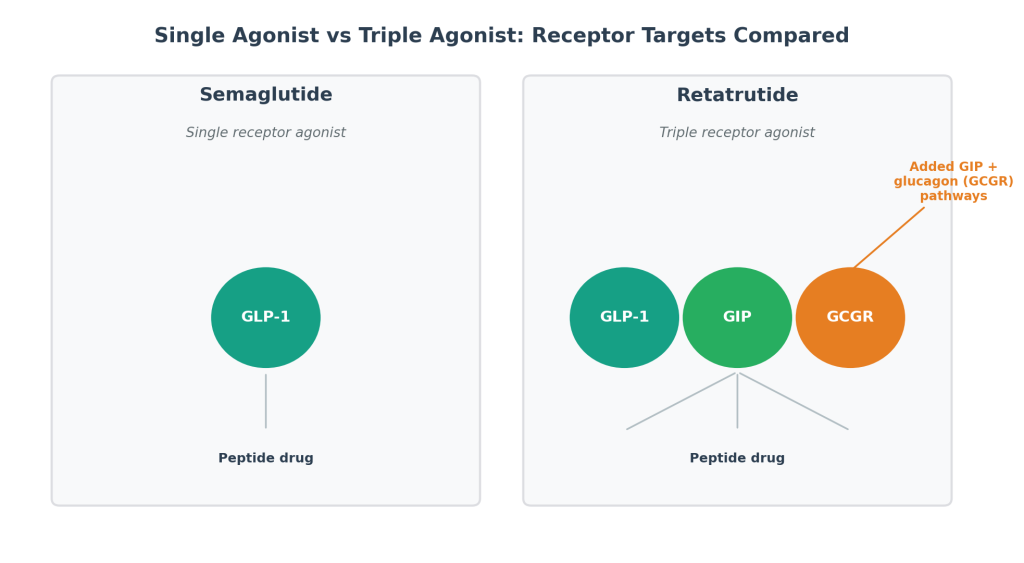
Retatrutide vs Semaglutide: What You Need to Know Before Comparing Them

Retatrutide vs Semaglutide: Quick Comparison: Retatrutide vs Semaglutide   Semaglutide Retatrutide Receptor targets GLP-1 (single agonist) GLP-1, GIP, glucagon (triple agonist) Developer Novo Nordisk Eli Lilly Regulatory status FDA/MHRA approved Phase 3, not approved anywhere Brand names Ozempic, Wegovy, Rybelsus None (investigational) Peak trial weight loss ~14.9%–20.7% (STEP 1 / STEP UP) 28.3%–30.3% (TRIUMPH-1) Administration

Retatrutide vs Semaglutide: What You Need to Know Before Comparing Them Read More »

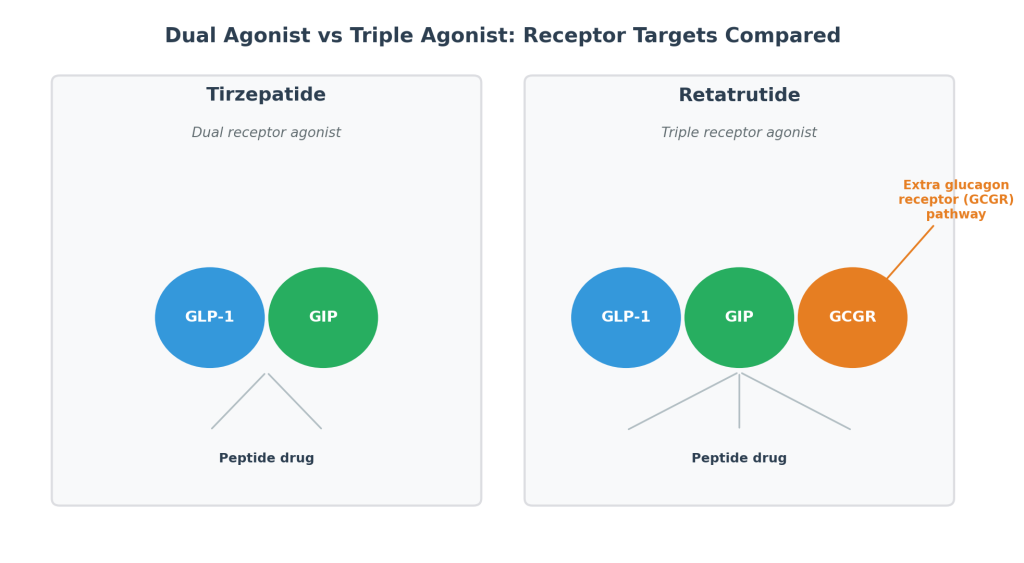
Diagram comparing tirzepatide's dual glp-1/gip receptor agonism with retatrutide's triple glp-1/gip/glucagon receptor agonism

Retatrutide vs Tirzepatide: Mechanism, Trial Results & Safety Compared (2026)

Retatrutide vs Tirzepatide: What You Need to Know Before Comparing Them Two names dominate current discussion of next-generation weight-management drugs: tirzepatide, an approved and prescribed medicine, and retatrutide, an investigational compound still completing Phase 3 trials. They’re frequently searched together because they work on overlapping biology — but they are not interchangeable, and as of

Retatrutide vs Tirzepatide: Mechanism, Trial Results & Safety Compared (2026) Read More »

Types of research peptides infographic showing structural peptide classifications including linear, cyclic, branched, and stapled peptides alongside functional categories such as metabolic, endocrine, regenerative, neuropeptide, immune-modulating, and antimicrobial peptides used in peptide research uk.

Types of Research Peptides: A Full Classification Guide

Types of Research Peptides Understanding the types of research peptides is essential for interpreting scientific literature, evaluating research quality, and designing effective experiments. While peptides are often discussed as a single category, researchers classify them in multiple ways depending on their structure, manufacturing process, biological function, receptor targets, and research applications. If you’re new to

Types of Research Peptides: A Full Classification Guide Read More »

Diagram of a peptide ligand binding a cell-surface receptor and triggering an intracellular signal transduction cascade

How Do Peptides Work? Receptor Binding and Cellular Signalling Explained

How Do Peptides Work? Receptor Binding and Cellular Signalling Explained Peptides don’t act like drugs that flood a system and produce a blunt effect. Most function as signalling molecules — precise biochemical messages that bind to specific targets on or inside a cell and trigger a defined chain of downstream events. Understanding this signalling logic

How Do Peptides Work? Receptor Binding and Cellular Signalling Explained Read More »

Diagram of a peptide bond forming between two amino acids showing n-terminus and c-terminus

What Are Peptides? A Complete Introduction for Institutional Researchers

What Are Peptides? A Complete Introduction for Institutional Researchers Peptides are short chains of amino acids linked together by peptide bonds. They sit at the midpoint of biological complexity — larger and more structured than a single amino acid, but smaller and simpler than a full protein. For anyone working in peptide research UK settings,

What Are Peptides? A Complete Introduction for Institutional Researchers Read More »

Retatrutide Comparisons: vs Tirzepatide, Semaglutide & More

Retatrutide comparisons A quick orientation: what’s actually approved Before comparing efficacy figures, it’s worth being clear about where each compound sits in the regulatory picture, since this changes what kind of evidence is even available. Compound Receptor targets UK/US regulatory status Semaglutide GLP-1 Approved (Ozempic, Wegovy) Tirzepatide GLP-1, GIP Approved (Mounjaro, Zepbound) Retatrutide GLP-1, GIP,

Retatrutide Comparisons: vs Tirzepatide, Semaglutide & More Read More »

Shopping Basket